Saturday, December 10, 2011

Inspired #4 - Steve Jobs


On October 5, Steve Jobs passed away due to the relapse of his pancreatic cancer. Steve Jobs is perhaps the most inspirational and controversial leader the tech industry has ever seen. Everything that Steve Jobs touched turned to gold and became widely successful. He was not without critics however, who argued that he never truly invented anything. Instead, he simply tweaked other people's idea to fit his vision. Despite what your opinion of Steve Jobs is, the tech industry lost a giant they can never replace.

I find myself more on the side that Steve Jobs did not invent anything and simply tweaked other people's ideas. While he may not have ever invented something, he was the best at what he did. Steve Jobs could see the flaws in other people's designs, and he would not rest until he recreated that product in his perfect vision. He changed the entire MP3 player market, because he thought that every product on the market "truly sucked." Therefore, Steve Jobs went to work at perfecting the MP3 player and introduced the world to the iPod in 2001. The iPod completely revolutionized the market and remains the number one MP3 player in the United States today. When Steve Jobs saw the cell phone and tablet markets, he went through the exact same process as he did with the MP3. Today, it is almost impossible to find a phone that does not have at least he most basic "Smartphone" technologies. By introducing the iPad, Jobs once again revolutionized a market once thought dead. Owning a tablet computer suddenly became the newest thing that you needed to have. Before the iPad tablets, were clunky and required a stylus to operate. Now, tablets no longer require a stylus and instead operate using the multi-touch systems.

While I do not want to speak ill of the dead, I have unfortunately lost some respect for Steve Jobs after the release of his official biography. In his biography, it is quite apparent that Steve Jobs does not appreciate anybody tweaking "his" ideas.  In his biography Steve Jobs said, 

Our lawsuit is saying, “Google, you fucking ripped off the iPhone, wholesale ripped us off.” Grand theft. I will spend my last dying breath if I need to, and I will spend every penny of Apple’s $40 billion in the bank, to right this wrong. I’m going to destroy Android, because it’s a stolen product. I’m willing to go to thermonuclear war on this. They are scared to death, because they know they are guilty. Outside of Search, Google’s products—Android, Google Docs—are shit.
Personally, I find Steve Jobs views to be entirely hypocritical. He made his entire career based on tweaking other people's ideas. Throughout his career, Jobs took other people's idea and made them fit his vision. However, when somebody does the exact same thing to him he is furious. How can he base his entire career off other people's ideas and then are made when somebody else "copies" him?  Perhaps Bill Gates said it best when he said, "I think there’s more than one way of looking at it. I think it’s more like we both had this rich neighbor named Xerox and I broke into his house to steal the TV set and found out that you had already stolen it.”

http://www.newyorker.com/reporting/2011/11/14/111114fa_fact_gladwell

Inspired #2 - Anonymous


Last year around this time, Anonymous became a household name across America. In response to the treatment of Bradley Manning and Wikileaks, Anonymous launched a series of attacks across the internet. Anonymous Targets of Anonymous included Amazon, MasterCard, PayPal, Visa and Sony. Through a coordinated distributed denial of service attack, Anonymous brought successfully brought down the websites of MasterCard, PayPal and Visa. 

The attacks by Anonymous were not the first attacks from the hacker organization. In 2008, Anonymous targeted the Church of Scientology after the church tried to take down a video of a Tom Cruise interview. Called Project Chanology, Anonymous began a series of attacks against the church. A few methods of attacks included: distributed denial of service attack, black faxes, prank calls, and pizza deliveries. Eventually, the group planned a series of protests against the Church at various locations around the world. As part of the protest, the protestors wore Guy Fawkes masks from V for Vendetta. The Guy Fawkes Mask would become the symbol of anonymous. 

The rise of groups like Anonymous certainly raises interesting ethical questions for the public. The actions of Anonymous are not simply hacking in the traditional sense. Instead, these groups are participating in the rise of hacktivism. Hacktivism is the use of computers and computer networks as a means to promote political ends. Just last year, the public became more aware of hacktivism as Anonymous and Lulz Sec both participated in Operation #AntiSec following the Wikileaks backlash.
Anonymous and the rise of hacktivism raises serious ethical concerns that we as a society will need to address in the near future. As a society will we treat hacktivism as another form of activism or will we consider it cyber terrorism? There is no easy answer as both sides of the argument have valid arguments and concerns. If you consider hacktivism a valid form of activism, where do you draw the line between activism and hacking? If someone were to hack Bank of America and stole money protesting the mortgage crisis, would that be considered hacktivism or hacking? The line between hacking and hacktivism is razor thin, and groups like anonymous walk that line every time they operate. The sooner we develop a standard as a society, the better off we will be.

Personally, I find myself constantly in an internal debate between whether Anonymous is a benefit or negative portion of society. As an organization, Anonymous has done both good and bad for the society as a whole. One day they may be shutting down Visa and MasterCard; the next they are shutting down a child pornography network. The "anonymous" nature of the organization certainly does not make it easier for me to make my mind up on the nature of the organization. Anybody on the Internet could claim that Anonymous s did something, because no one really knows whom Anonymous is. Good or bad the actions of Anonymous have done one thing spectacularly well. Anonymous and Lulz Sec have pointed out the pathetic nature of our cyber-security initiatives to the non-technological public. People tend to panic when "hackers" hacked the Central Intelligence Agency. While the CIA hack was a joke, it will at least generate a public discussion on cyber security initiatives in the United States.

Inspired #1 - Stop Online Piracy Act


The Stop Online Piracy Act is one of the most infuriating and misguided bills to be introduced to Congress recently. Introduced on October 26, 2011 the bill is "designed" to improve law enforcements and copyright holder's ability to combat online trafficking in intellectual property and counterfeit goods.[1] Under SOPA, the Justice Department can shut down any web site that is accused of facilitating or enabling copyright infringement. Instead, the bill is simply nothing more than an entertainment industry written bill to protect antiquated business models.
Since the creation of the Internet, the entertainment industry has struggled to adapt and evolve. For years, they have tried attacking anyone that illegally downloads their content. However, as one site shuts down, a new website springs up within hours containing the exact same information. Under SOPA, sites would face a lower burden of guilt before facing removal. It is likely that under SOPA, the Department of Justice could remove legitimate websites all because a user posted copyright material. Under SOPA, YouTube must remove thousands of videos or face removal by the Department of Justice. 

My biggest problem with SOPA is that it painfully obvious that lobbyists bought and paid for the Congressional representatives who introduced the bill. Just last week, it Politico revealed that two senior congressional aides who wrote the very bill are now working as lobbyists. What bill are they working on lobbying for Congress to pass? They are now lobbyists for SOPA, the very bill that they wrote. The very wrote people who wrote the bill, are now being paid for by the entertainment industry to lobby for the bill. This just screams of a massive conflict of interest and absolutely sickens me. American people will suffer because the entertainment industry is stuck in 1992.
Instead of working to shut down these sites, the entertainment industry needs to create new functional business models. The old models do not work anymore and the entertainment industry refuses to accept that. Why would someone pay for a movie when I can download it online with less hassle? If I buy a legitimate copy of a movie, I have to sit through minutes of content that I am unable to skip. Meanwhile, if I had downloaded the same movie online I do not have to watch that content. Why punish users who buy legitimate copies of a movie? Steam and Netflix have shown that alternate business models can work in the age of the Internet.  

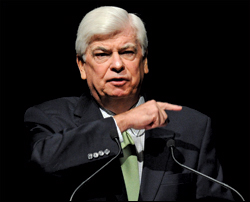
I am very much against this horror of a bill that pretends to protect America's best interests. The bill is nothing more than entertainment industry backed garbage that pretends to be in America's best interests. Many experts have argued that this bill will create "The Great American Firewall" similar to the Chinese. Millions of other Americans and I all agree that we do not want to see "The Great American Firewall." Nevertheless, that seems that is what MPAA Chairman Chris Dodd wants to see for America when he said, " When the Chinese told Google that they had to block sites or they couldn't do [business] in their country, they managed to figure out how to block sites[2]."


[1] http://www.washingtonpost.com/blogs/post-tech/post/house-introduces-internet-piracy-bill/2011/10/26/gIQA0f5xJM_blog.html
[2] http://www.variety.com/article/VR1118047080

Monday, December 5, 2011

Required #12(Late) - CSIS Trip


This week we had the opportunity to travel to the Center for Strategic and International Studies in Washington D.C. I would like to thank CSIS for the accommodations they provided on our three-day trip. Between the various speakers, the policy simulation, and dinner at 1789, there was not a part of the trip I did not enjoy. After this trip, I would definitely consider working at CSIS in the future if offered the opportunity.

The guest speakers from CSIS dominated most of the time that we spent at CSIS. Prior to departing for CSIS, I was concerned that listening to guest speakers for eight hours would be exhausting. After listening to the various speakers, I can safely say that I was never bored or mentally exhausted. Every speaker that we listened to was engaging and an expert in the field that they worked in. Some of our guest speakers included James Lewis, Arnaud de Borchgrave, Heather Conley and Richard Jackson. These speakers covered a wide range of topics from Cyber security to Global Aging to Prospects on Africa.

Arnaud Borchgrave was one speaker that specifically stood out to the class. Arnaud Borchgrave is an award-winning journalist who has been around the world covering the most important issues since 1947. Throughout his career, Arnaud interviewed a wide range of world leaders that included Muammar Gaddafi, Saddam Hussein, and Pham Van Dong. Instead of speaking one a specific issue, Arnaud answered our questions for an hour. I am thankful that Arnaud chose this method, as the various stories he had from his career were fascinating. Perhaps the greatest quote that Arnaud Borchgrave said was regarding the budget super committee. "The super committee is like two drunks arguing about the bar tab as the Titanic is sinking." 

On the second half of the second day, we began our Cyber Security Policy simulation. Going into the simulation, no one in the class had any idea what was going to happen. While we had read about cyber security issues, no one would tell us what would happen in the simulation. This year's simulation began when all power in to the City of Chicago was shutdown. Our job was to design a response to the situation, as well as create a three-pillar United States Cyber security Policy. Our team's response to the Chicago simulation was to begin providing immediate relief to Chicago, while avoiding the blame game internationally. Our three-pillar cyber security revolved around the issues James Lewis discussed in his talk as well as the class readings. After briefing the president, we received feedback as well as an update to the situation. The situation update involved the crash of the Chinese stock markets. Finally, we had to present our final policy as well as the United States response to the Chinese stock markets. When it was all finished, our team ended up winning the competition.

Overall, this trip was a great experience and helped me learn more about how think tanks help shape public policy. I would definitely recommend anyone interested in working in this field take this class next fall. The experiences gained during this semester are impossible to replicate outside of an internship. After this class, I am definitely going to explore obtaining an internship at CSIS this summer.

Required #11(Late)- CSIS Readings


This week we were responsible for reading the articles sent to us by the Center for Strategic and International Studies. The readings included the Department of Defense Strategy for Operating in Cyberspace, Whitehouse Cyberspace Policy Review, Significance of the Frontier: Why Privacy and Cybersecurity Clash, and the Global Forecast 2011. CSIS sent these particular readings to prepare us for the trip to Washington D.C. later in the semester. The first three readings prepared us for the simulation we would partake in, while the Global Forecast 2011 gave us a better idea of what areas CSIS covers.


Defense Spending and Deficit Reductions:  Funding the Future article from the Global Forecast 2011 generated the most discussion of all the articles. In Defense Spending and Deficit Reductions, David Berteau argued that the Department of Defense needed to take significant cuts as part of the budget crisis negotiations. When reading the article, I felt that the author did not fully consider the implications slashing the Defense budget would have on the United States Military. History has shown that slashing the military budget without a concern for the size of future forces does not work. Following the First Gulf War, the United States began cutting the military budget and shrinking the size of the Armed Forces. When the Wars in Afghanistan and Iraq started the United States suddenly found itself too small of a force. 

In class, I tried to argue that it would take ten to fifteen years to realize the full effects of shrinking the size of the military. Unlike Corporate America, you cannot hire somebody off the street to fulfill middle management needs. The structure of the American Armed Forces requires that you spend 5-10 years in the military before you reach the ranks of Field grade officers and non-commissioned officers. I argued that the military should have a larger role in how the Department of Defense is affected by the budget crises to help prevent these future concerns.

Cyber security dominated the remaining discussion the rest of the week as we analyzed the various cyber security readings from CSIS. Throughout our discussions, constantly I found myself internally debating the role of the government in protecting "Cyberspace." Should the government be responsible for the protection of the Internet or should the free-market take that role? Throughout these internal debates, I kept thinking back to recent news, but these events only made the situation murkier. Recent efforts by groups like Anonymous and Lulz Sec demonstrated the need for the Federal Government to improve defenses to protect critical infrastructure. Meanwhile, the Stop Online Piracy Act introduced in Congress is nothing more than the Entertainment industry's wet dream. The bill does nothing to protect critical infrastructure and only works to try to save the Entertainment industry from themselves by radically enforcing antique operating methods.

In the end, cyber security remains a tricky balancing system between the free-market and governmental intervention. Ideally, the Government would create methods to protect critical governmental infrastructure while leaving the rest to the free-market. Unfortunately, the Entertainment industry will remain a constant thorn in the achievement a rational cyber security policy. For them, protecting antiquated models is more important than protecting our critical infrastructure from hackers.