Saturday, December 10, 2011

Inspired #1 - Stop Online Piracy Act


The Stop Online Piracy Act is one of the most infuriating and misguided bills to be introduced to Congress recently. Introduced on October 26, 2011 the bill is "designed" to improve law enforcements and copyright holder's ability to combat online trafficking in intellectual property and counterfeit goods.[1] Under SOPA, the Justice Department can shut down any web site that is accused of facilitating or enabling copyright infringement. Instead, the bill is simply nothing more than an entertainment industry written bill to protect antiquated business models.
Since the creation of the Internet, the entertainment industry has struggled to adapt and evolve. For years, they have tried attacking anyone that illegally downloads their content. However, as one site shuts down, a new website springs up within hours containing the exact same information. Under SOPA, sites would face a lower burden of guilt before facing removal. It is likely that under SOPA, the Department of Justice could remove legitimate websites all because a user posted copyright material. Under SOPA, YouTube must remove thousands of videos or face removal by the Department of Justice. 

My biggest problem with SOPA is that it painfully obvious that lobbyists bought and paid for the Congressional representatives who introduced the bill. Just last week, it Politico revealed that two senior congressional aides who wrote the very bill are now working as lobbyists. What bill are they working on lobbying for Congress to pass? They are now lobbyists for SOPA, the very bill that they wrote. The very wrote people who wrote the bill, are now being paid for by the entertainment industry to lobby for the bill. This just screams of a massive conflict of interest and absolutely sickens me. American people will suffer because the entertainment industry is stuck in 1992.
Instead of working to shut down these sites, the entertainment industry needs to create new functional business models. The old models do not work anymore and the entertainment industry refuses to accept that. Why would someone pay for a movie when I can download it online with less hassle? If I buy a legitimate copy of a movie, I have to sit through minutes of content that I am unable to skip. Meanwhile, if I had downloaded the same movie online I do not have to watch that content. Why punish users who buy legitimate copies of a movie? Steam and Netflix have shown that alternate business models can work in the age of the Internet.  
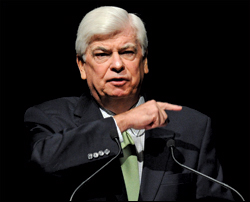
I am very much against this horror of a bill that pretends to protect America's best interests. The bill is nothing more than entertainment industry backed garbage that pretends to be in America's best interests. Many experts have argued that this bill will create "The Great American Firewall" similar to the Chinese. Millions of other Americans and I all agree that we do not want to see "The Great American Firewall." Nevertheless, that seems that is what MPAA Chairman Chris Dodd wants to see for America when he said, " When the Chinese told Google that they had to block sites or they couldn't do [business] in their country, they managed to figure out how to block sites[2]."


[1] http://www.washingtonpost.com/blogs/post-tech/post/house-introduces-internet-piracy-bill/2011/10/26/gIQA0f5xJM_blog.html
[2] http://www.variety.com/article/VR1118047080

Monday, December 5, 2011

Required #12(Late) - CSIS Trip


This week we had the opportunity to travel to the Center for Strategic and International Studies in Washington D.C. I would like to thank CSIS for the accommodations they provided on our three-day trip. Between the various speakers, the policy simulation, and dinner at 1789, there was not a part of the trip I did not enjoy. After this trip, I would definitely consider working at CSIS in the future if offered the opportunity.

The guest speakers from CSIS dominated most of the time that we spent at CSIS. Prior to departing for CSIS, I was concerned that listening to guest speakers for eight hours would be exhausting. After listening to the various speakers, I can safely say that I was never bored or mentally exhausted. Every speaker that we listened to was engaging and an expert in the field that they worked in. Some of our guest speakers included James Lewis, Arnaud de Borchgrave, Heather Conley and Richard Jackson. These speakers covered a wide range of topics from Cyber security to Global Aging to Prospects on Africa.

Arnaud Borchgrave was one speaker that specifically stood out to the class. Arnaud Borchgrave is an award-winning journalist who has been around the world covering the most important issues since 1947. Throughout his career, Arnaud interviewed a wide range of world leaders that included Muammar Gaddafi, Saddam Hussein, and Pham Van Dong. Instead of speaking one a specific issue, Arnaud answered our questions for an hour. I am thankful that Arnaud chose this method, as the various stories he had from his career were fascinating. Perhaps the greatest quote that Arnaud Borchgrave said was regarding the budget super committee. "The super committee is like two drunks arguing about the bar tab as the Titanic is sinking." 

On the second half of the second day, we began our Cyber Security Policy simulation. Going into the simulation, no one in the class had any idea what was going to happen. While we had read about cyber security issues, no one would tell us what would happen in the simulation. This year's simulation began when all power in to the City of Chicago was shutdown. Our job was to design a response to the situation, as well as create a three-pillar United States Cyber security Policy. Our team's response to the Chicago simulation was to begin providing immediate relief to Chicago, while avoiding the blame game internationally. Our three-pillar cyber security revolved around the issues James Lewis discussed in his talk as well as the class readings. After briefing the president, we received feedback as well as an update to the situation. The situation update involved the crash of the Chinese stock markets. Finally, we had to present our final policy as well as the United States response to the Chinese stock markets. When it was all finished, our team ended up winning the competition.

Overall, this trip was a great experience and helped me learn more about how think tanks help shape public policy. I would definitely recommend anyone interested in working in this field take this class next fall. The experiences gained during this semester are impossible to replicate outside of an internship. After this class, I am definitely going to explore obtaining an internship at CSIS this summer.

Required #11(Late)- CSIS Readings


This week we were responsible for reading the articles sent to us by the Center for Strategic and International Studies. The readings included the Department of Defense Strategy for Operating in Cyberspace, Whitehouse Cyberspace Policy Review, Significance of the Frontier: Why Privacy and Cybersecurity Clash, and the Global Forecast 2011. CSIS sent these particular readings to prepare us for the trip to Washington D.C. later in the semester. The first three readings prepared us for the simulation we would partake in, while the Global Forecast 2011 gave us a better idea of what areas CSIS covers.


Defense Spending and Deficit Reductions:  Funding the Future article from the Global Forecast 2011 generated the most discussion of all the articles. In Defense Spending and Deficit Reductions, David Berteau argued that the Department of Defense needed to take significant cuts as part of the budget crisis negotiations. When reading the article, I felt that the author did not fully consider the implications slashing the Defense budget would have on the United States Military. History has shown that slashing the military budget without a concern for the size of future forces does not work. Following the First Gulf War, the United States began cutting the military budget and shrinking the size of the Armed Forces. When the Wars in Afghanistan and Iraq started the United States suddenly found itself too small of a force. 

In class, I tried to argue that it would take ten to fifteen years to realize the full effects of shrinking the size of the military. Unlike Corporate America, you cannot hire somebody off the street to fulfill middle management needs. The structure of the American Armed Forces requires that you spend 5-10 years in the military before you reach the ranks of Field grade officers and non-commissioned officers. I argued that the military should have a larger role in how the Department of Defense is affected by the budget crises to help prevent these future concerns.

Cyber security dominated the remaining discussion the rest of the week as we analyzed the various cyber security readings from CSIS. Throughout our discussions, constantly I found myself internally debating the role of the government in protecting "Cyberspace." Should the government be responsible for the protection of the Internet or should the free-market take that role? Throughout these internal debates, I kept thinking back to recent news, but these events only made the situation murkier. Recent efforts by groups like Anonymous and Lulz Sec demonstrated the need for the Federal Government to improve defenses to protect critical infrastructure. Meanwhile, the Stop Online Piracy Act introduced in Congress is nothing more than the Entertainment industry's wet dream. The bill does nothing to protect critical infrastructure and only works to try to save the Entertainment industry from themselves by radically enforcing antique operating methods.

In the end, cyber security remains a tricky balancing system between the free-market and governmental intervention. Ideally, the Government would create methods to protect critical governmental infrastructure while leaving the rest to the free-market. Unfortunately, the Entertainment industry will remain a constant thorn in the achievement a rational cyber security policy. For them, protecting antiquated models is more important than protecting our critical infrastructure from hackers.

Thursday, December 1, 2011

Required #10 (Late) - Digitial Diplomacy


The week's topic of Digital Diplomacy is certainly interesting after listening to Phillip J. Crowley speak about Wikileaks. Between the readings, speaking with Professor Don Shemanski, and PJ Crowley I can safely say that diplomacy has radically changed in the last ten years. Previously, diplomacy used to happen one on one with other diplomats. Now, diplomacy happens live in a public setting with billions of other spectators. All it takes is a person with a cell phone and a Twitter account to start frenzy across the Internet. 

Recent events demonstrate exactly how the old ways of acting no apply in diplomacy and world events. When Osama Bin Laden died, I did not find about it from reading the newspaper or watching CNN. Instead, I discovered that Osama Bin Laden was dead after I logged onto Facebook after being Portal for the first time. Almost an hour and a half passed from when I first discovered that Osama was dead to the time of President Obama's Press Conference. In that time, enough people had gathered in Beaver Canyon to "riot." If the old models still applied, people would not find discover Osama Bin Laden's death until the next morning when they read the newspaper. 

These new technologies are almost forcing these government organizations to become more transparent. While many would argue that transparency is a good thing, I am not fully convinced that it is in the diplomatic world. In the diplomatic world, diplomats frequently say things that would cause embarrassment should it reach the rest of the world. However, it is important that these diplomats recognize these embarrassments internally. If the world becomes so transparent that these conversations no longer happen, diplomacy will become that much tougher. Wikileaks demonstrates the problems of what happens when transparency no longer exists. In the future diplomats will be hesitant to write cables, similar to those contained in the Wikileaks release, for fears that the information will become public knowledge. This fear slows, and damages the Diplomatic community's ability to operate.

Another lesson that I learned reading Diplomacy in the Digital Age is that immediacy between events and required events is now much shorter. If a government does not jump on top a crisis immediately, than situations will spread like wildfires. While not a diplomatic situation, the differences in the response between Syracuse and Penn State highlight just how true this actually is. When faced with a sexual-abuse crisis, decision makers at Penn State decided to sit on the situation for a few days before issuing a response. The only initial response from Penn States was a misguided statement from President Spanier. Meanwhile when word spread of a potential sexual-abuse scandal at Syracuse, decision makers there jumped right on top of the crisis. Bernie Fine immediately found himself on administrative leave and out of a job just a few days later. By jumping on top of a crisis immediately, Syracuse was able to help shape the narrative that came out in the immediate aftermaths. Diplomats can apply the lessons learned from Penn State in the digital age of interconnectedness. Situations today, require an immediate response from those involved. If you do not jump on top of those situations immediately, you lose the ability to help shape the narrative that arises afterwards.

Required #9(Late) - 21st Century Statecraft


http://techchange.org/2010/08/23/21st-century-statecraft-what-does-it-really-mean/

This week we explored the topic of 21st Century Statecraft through a variety of academic and journalistic articles. What exactly is 21st Century Statecraft? The United States Department of State defines 21st Century Statecraft as, "The complementing of traditional foreign policy tools with newly innovated and adapted instruments of statecraft that fully leverage the networks, technologies, and demographics of our interconnected world[1]." The idea behind 21st Century Statecraft is leveraging technology to reach out to the people all around the world. Under this 21st Century Statecraft, mantra the United States has created various programs such as Text Haiti, mWomen, and the Apps for Africa Competition to just name a few. The United States is also using tools such as Facebook, Twitter and YouTube to spread the 21st Century Statecraft philosophy.

While I find the ideas of 21st Century interesting there are inherent concerns that arise with any governmental program. Some view these programs as simple tools to increase the influence that America has within that country. Once we have gained the influenced through these programs, we will begin trying to change them from within. While these fears are mostly unfounded, historically the United States has attempted those types of programs around the world. These concerns could lead to less people engaging with the State Department's programs

Within the current Federal government, no one is really prepared to take the lead on implementing these 21st Century Statecraft ideas. Jared Cohen used to his fill this role, until he took a job in the private industry to work for Google. Jared Cohen is perhaps most famous for asking Twitter to not go down for maintenance during the Iranian "Twitter Revolution." When reading the New York Times Article first about Jared Cohen, I thought that this 21st Century Statecraft thing could actually work. Then I read the Huffington Post article and discovered that Jared Cohen had left the State Department to work for Google. If Jared Cohen, the "father" of 21st Century Statecraft does not want to promote the idea, who in the Federal Government will?

Finally, a third problem with 21st century statecraft is that it may not even work as described. Research shows that the opinion of Muslim's who participated in the State Department's program was actually lower than those who had not participated. If the entire purpose of these programs to improve perception of America across the world, what have these programs actually accomplished? Without working to improve perception of America, these programs are a waste of money.
I recognize that I may be overly critical of these programs, but so far, they have not show the results promised. While 21st Century Statecraft is still in the infancy stage, the program lacks the leader to run with the idea and further develop it. I just do not see that person emerging when the Jared Cohen, the "father" of 21st Century Statecraft, leaves the State Department for Google. Unfortunately, the bureaucracy and red tape will make it difficult to incite the right people to work at the State Department and remain there. If the State Department ever finds the right leader for this program, I will reconsider my position on the idea. Until then, I find 21st Century Statecraft an interesting idea with terrible implementation.


[1] http://www.state.gov/statecraft/overview/index.htm       

Wednesday, November 30, 2011

Required #3(Late) - Friedman Retrospect


Since I am writing this blog much after the fact, I thought it best to look at Thomas Friedman’s The World is Flat retrospectively. Throughout the semester, I think I made my feelings regarding Thomas Friedman and The World Is Flat quite apparent. I found his style of writing to be frustrating and repetitive. Perhaps this stems from his background as a newspaper columnist, but it made reading The World is Flat a difficult endeavor. It did not help that the book was clearly out of date as he talked about as the book was clearly written a few years ago. Despite these flaws, looking back Thomas Friedman was not completely wrong. Even though some would say that The World is Flat is nothing more than a love letter to globalization, Friedman was right about some things.

One of the subjects I felt Friedman correctly identified was “The Steroids” as he called them. Friedman described the steroids as things like mobile phones, Voice over Internet Protocol (VoIP), and personal digital assistants. When Friedman wrote first wrote this book in 2005, cell phone use was just become widespread amongst the general population. When he released the latest edition in 2007, the IPhone had not even been released to the public yet. At the time, the Motorola RAZR was the most popular cell phone on the market.

Since 2007, "smart phones” have dominated the cell phone markets. These smart phones are just the very “steroids” that Friedman first imagined when he was imaging future flatteners. Today, I can take a picture, send that picture out as a tweet, and then get directions to my house all in one device. In 2007, I would have had to take out my digital camera, use my Garmin to get back home, and then download that picture to my home computer. After I had downloaded that picture, finally I would have uploaded that picture to Twitter. The cell phone has allowed the user to shape, manipulate and transmit information virtually on the go.

In The World is Flat, Friedman definitely over played the role of globalization going into the future however. While the world has become much more globalized, it has not come close to the levels that Friedman predicted. The world economic downturn definitely played a role in the hesitance for countries and companies to continue embracing globalization as they once had. Since the economies became so interconnected, the downturn spread to other economies around the world. Because of the global economic downturn, some countries have even considered the option of withdrawing from economic and political unions. The economic downturn was not the only reason why for globalized failed to reach the levels Friedman predicted.  After a certain point, the law of diminishing returns begins to apply to the application of globalization.

Overall, Friedman was definitely an interesting read and set the mood throughout our various course discussions. Perhaps If I had read The World is Flat when it was originally written, I would not have had such a problem with many of his arguments. However, reading them now many of the arguments just seem wrong.