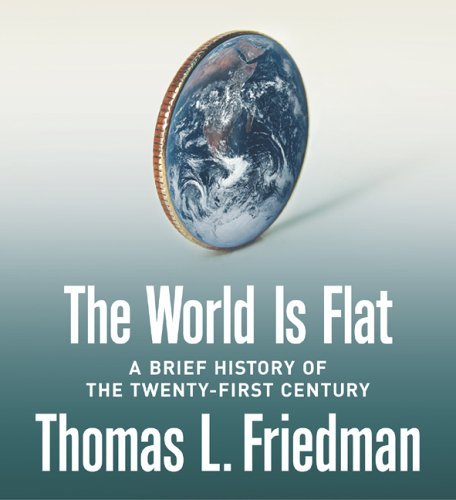
Since I am writing this blog much after the fact, I thought it
best to look at Thomas Friedman’s The World is Flat retrospectively.
Throughout the semester, I think I made my feelings regarding Thomas Friedman
and The World Is Flat quite apparent. I found his style of writing to be
frustrating and repetitive. Perhaps this stems from his background as a
newspaper columnist, but it made reading The World is Flat a difficult
endeavor. It did not help that the book was clearly out of date as he talked
about as the book was clearly written a few years ago. Despite these flaws,
looking back Thomas Friedman was not completely wrong. Even though some would
say that The World is Flat is nothing more than a love letter to
globalization, Friedman was right about some things.
One of the subjects I felt Friedman correctly identified was “The Steroids” as he called them. Friedman described the steroids as things like mobile phones, Voice over Internet Protocol (VoIP), and personal digital assistants. When Friedman wrote first wrote this book in 2005, cell phone use was just become widespread amongst the general population. When he released the latest edition in 2007, the IPhone had not even been released to the public yet. At the time, the Motorola RAZR was the most popular cell phone on the market.
Since 2007, "smart phones” have dominated the cell phone markets. These smart phones are just the very “steroids” that Friedman first imagined when he was imaging future flatteners. Today, I can take a picture, send that picture out as a tweet, and then get directions to my house all in one device. In 2007, I would have had to take out my digital camera, use my Garmin to get back home, and then download that picture to my home computer. After I had downloaded that picture, finally I would have uploaded that picture to Twitter. The cell phone has allowed the user to shape, manipulate and transmit information virtually on the go.

Overall, Friedman was definitely an interesting read and set the mood throughout our various course discussions. Perhaps If I had read The World is Flat when it was originally written, I would not have had such a problem with many of his arguments. However, reading them now many of the arguments just seem wrong.

Excellent point Rhys, I like how you find a positive for Friedman after all of the bashing we've done on him this semester. For all of his optimism and enthusiasm, he is an intelligent man, with an eye for the future. Granted he got quite a few of his predictions wrong, but his steroids were certainly prescient. I think you touch on something very important in your post too, that it isn't just the item itself, but what it enables that makes it useful and valuable. In the smartphone's case, it's the internet access.
ReplyDeleteTwo years ago, if you'd told me I needed to buy an iPhone so that I could surf the internet on my phone, I would have laughed at you - it just wasn't something I felt I needed.
Now that 3G and 4G service are commonplace, and developers have created uses for an internet capable phone, from paying bills, to calling overseas for free, to navigating a strange neighborhood home, you can do almost anything.
I do think that the recession has had a sizeable effect on Friedman's prediction accuracy as well - much of his optimism was born of a happier age, where America's economic growth continued to forge onwards. Now that America's economy is weakened, it is harder to be optimistic and now Friedman doesn't look quite as good.