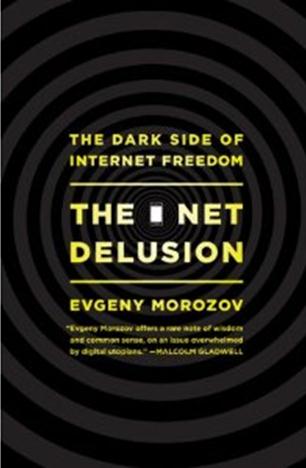
I found The Net Delusion by Evgeny Morozov to be a fascinating read. Prior to reading this book, I was aware of some of the dangers of technology but not to the extent, that Morozov described. Morozov warned that for every "good" thing that a person can do with new technologies, someone is using that exact same technology for "bad." Morozov also spends most of his book attacking the ideas presented by Friedman in The World is Flat. As a Friedman-hater, I found myself agreeing with the ideas presented by Morozov in this book. I thought that Morozov did a great job of presenting examples to support his ideas throughout this book.

Prior to this class, we had discussed how groups like Ushahidi are using text-messaging services for good. However, Morozov describes how that text messaging is also being used for incite hate across the globe. The story that stood out to me about the danger of text messaging was that of the Xuri Toy Factory. An internet article claimed, "Six Xinjian boys raped two innocent girls at the Xuri Toy Factory." Ten days after the article went live, a mob of angry Han people attacked a group of Uighur factory workers killed two and injuring hundreds. Both sides then used cell phones to mobilize. Eventually, the problem got so bad that officials had to shut down phone communications. Authorities discovered that the article was wrong and a disgruntled ex-employee fired by the Xuri Toy Factory had posted it.
The Uighur-Han clash in 2009 highlights two problems with new technologies. The first problem was the use of cell phones to incite hate. Cell phones allowed members to spread rumors concerning the factory attack. These rumors overstated the situation and mobilized both sides causing further conflict. Cell phones also helped the spread of a viral video showing factory workers beaten by an angry mob with metal pipes. Had cell phones not existed, this conflict would not have reached the heights that it had. Protestors on both sides would not have been able to mobilize their side to cause further damage. While Ushahidi shows one use of text-messaging services for good. However, the Uighur-Han clash shows one of the "bad" uses of text-messaging services.

The second problem highlighted by the Uighur-Han clash was the ability of a disgruntled ex-employee to post a news article online anonymously. Both Chinese officials and foreign journalists were unable to verify the credibility of the reports in the article. Instead of verifying the author or the contents of the article, the angry Han people formed a mob to attack the Xuri Toy Factory. Had they taken the time to verify the content, they may have realized that article was not credible. One of the problems with the Internet is the ability for anyone to post anything they want online. No longer can people assume what they read is credible, instead they must determine if the source is credible or not. Anybody in the world could post an article online claiming almost anything. If people found that person to be credible, the readers would believe that the information posted is correct. This makes it very easier for people to influence world events more than ever before.

Rhys,
ReplyDeleteI too enjoyed Morosov's book, and I agree that despite Friedman's insistences, technological advances especially those that involve the internet or similar communication technology offer up just as many risks as rewards. While Americans can often be proud of our tendency towards optimism, sometimes it is necessary to temper our enthusiasm with caution. Particularly when we benefit so much from the status quo, we should be careful not to upset it in our efforts to forge ahead. As exciting as innovation is, innovation for its own sake is not always desirable.
That said, I am always leary when someone criticizes the anonymity of the internet. You don't outright suggest establishing some form of identification for internet users, but nevertheless I feel strongly that such an action would do much more harm than good. Personally I would rather be responsible for judging the validity of the content I read on the internet than giving up my privacy for the convenience and "safety" of others. I ascribe to the old Ben Franklin quote: "He that sacrifices liberty for security deserves neither". Especially in a nation that prizes individual rights and responsiblities as much as the United States, I feel that we should be responsible for our action online without government interference. Perhaps it is unrealistic, but I'd much rather live in country with an ineffective government than one that controls every means of communication and could become Orwellian in short order.
Matthew Farley